Complete Forged Fittings Weight Chart 2026 With Technical Data
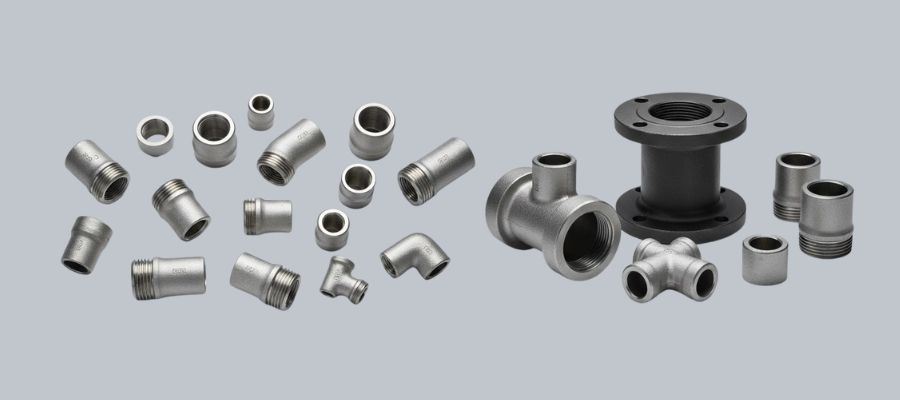
Forged Fittings Weight Chart KG MM PDF
Forged Fittings Manufacturers provide robust and dependable piping connection materials in oil and gas, petrochemical, power, refinery, and heavy engineering sectors. Forged fittings are manufactured using solid billets, which are subjected to controlled forging, and this means they are stronger, uniform in structure, and have a better ability to handle pressure as compared to cast fittings. Typical types of forged fittings are elbows, tees, couplings, unions, plugs, and caps, which are intended to operate safely in high-pressure and high temperature piping systems.
Forged fittings are used where leakage resistance, dimensional accuracy, and extended service life are of importance. These widely apply to the carbon steel, stainless steel, alloy steel, and nickel alloy piping systems. To complete the compatibility of the system, the manufacturers also supply other piping accessories like forged flanges and forged valves to match the forged fittings. The correct weight and dimensions data are significant to project estimation, load, transportation planning, and site handling.
A Forged Fittings Weight Chart KG MM PDF can help the engineers, contractors, and procurement teams clearly understand the correlation between size, pressure class, and weight of every fitting. Weight charts are useful in planning the material to use in large pipelines, as the buyer can easily estimate the weight of the total shipments to make, the support load, and the effort involved in the installation of the pipeline. Forged fittings are normally produced in the form of socket weld and threaded fittings and of varying pressure ratings to fit various operating conditions.
The data of the Forged Fittings Weight Chart is particularly helpful in the stages of piping design and project implementation. It also makes a proper choice of fittings according to the size of the pipe, wall thickness, and pressure category, which will not cause any mismatch when installing the fittings. Faked fittings are produced according to the world standards, including ASME and ASTM, and these standards offer uniformity, safety, and interchangeability of the fittings across any given project worldwide.
Forged Fittings Weight Chart, Forged Fittings Weight per Piece, Forged Fittings Weight Chart in KG, Forged Fittings Chart in MM, Forged Fittings Specification PDF, Forged Fittings Screws Weight Calculator.
Weight Chart Tables
Chart 1: Forged Socket Weld Fittings Weight Chart
| Nominal Pipe Size (NPS) | 90° Elbow (kg) | Tee (kg) | Coupling (kg) | Union (kg) |
|---|---|---|---|---|
| 1/2" | 0.18 | 0.24 | 0.14 | 0.22 |
| 3/4" | 0.30 | 0.40 | 0.22 | 0.35 |
| 1" | 0.55 | 0.70 | 0.40 | 0.65 |
| 1 1/2" | 1.10 | 1.40 | 0.85 | 1.30 |
| 2" | 1.80 | 2.30 | 1.45 | 2.10 |
Chart 2: Forged Fittings Material Grades & Pressure Class
| Material Grade | Standard | Pressure Class | Operating Temp (°C) | Typical Applications |
|---|---|---|---|---|
| Carbon Steel A105 | ASTM A105 | 3000 / 6000 | -29 to 425 | Oil & gas pipelines |
| Stainless Steel F304 | ASTM A182 | 3000 / 6000 | -196 to 800 | Chemical plants |
| Stainless Steel F316 | ASTM A182 | 3000 / 6000 | -196 to 870 | Marine & offshore |
| Alloy Steel F11 | ASTM A182 | 3000 / 6000 | -29 to 540 | Power plants |
| Alloy Steel F22 | ASTM A182 | 3000 / 6000 | -29 to 580 | High-temperature service |
Chart 3: Forged Threaded Fittings Weight Chart
| Nominal Pipe Size (NPS) | 90° Elbow (kg) | Tee (kg) | Plug (kg) | Cap (kg) |
|---|---|---|---|---|
| 1/2" | 0.16 | 0.22 | 0.10 | 0.12 |
| 3/4" | 0.28 | 0.36 | 0.18 | 0.20 |
| 1" | 0.50 | 0.65 | 0.32 | 0.35 |
| 1 1/2" | 1.00 | 1.25 | 0.70 | 0.75 |
| 2" | 1.65 | 2.10 | 1.20 | 1.30 |
Forged fittings in small diameter piping systems are commonly threaded, and where welding is not a preferred method of joining and ease of installation is desired, are used.
Forged fittings are also available as a reliable method of use in systems that involve extremely important piping, where pressure integrity, strength, and durability cannot be sacrificed. Having a correct Forged Fittings Weight Chart KG MM PDF is a tool to conduct the industrial piping projects planning, effective procurement, and flawless execution in the oil and gas, petrochemical, power generation, and heavy engineering sectors.
For updates and additional information, follow on social media platforms.
Social Media: LinkedIn, Instagram, Facebook, Pinterest.