Integrally Finned Tubes, Extruded One Piece Fins, High Heat Transfer Efficiency, Manufacturer In India
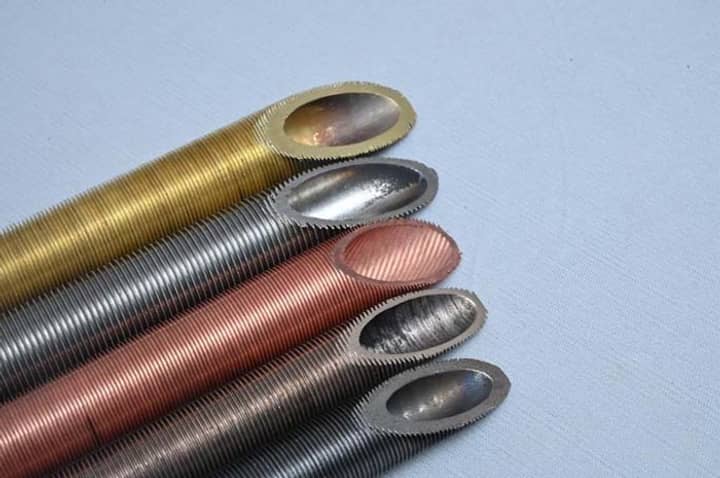
| Fin Thickness | Minimum 0.8mm, Maximum 3 Mm |
|---|---|
| Fin Height | 1.5″(38 Mm), Minimum 0.25″(6.35 Mm) |
| Fin Density : | Minimum 46 Fins Per Meter, Maximum 287 Fins Per Meter |
| Material | Carbon Steel, Stainless Steel, Alloy Steel, Inconel, High Nickle & Incolloy |
| Tubes Diameter | 30mm Od Minimum, 220mm Od Maximum |
Integrally Finned Tubes for Boilers Heat Exchangers and Thermal Systems Supplier in India
Timex Metals which specializes in provision of efficient thermal engineering services to challenging industrial conditions is an established Integrally Finned Tube Manufacturer that offers high quality tubes that are engineered to offer excellent heat transfer features and high life cycle. Power generation plants, petrochemical facilities, HVAC systems, and refineries where thermal efficiency is important are important users of integrally finned tubes. These tubes are produced through high-technology extrusion technology which provides a high degree of metallurgical bonding between the fins and the base tube, which increases the ability to dissipate heat and structural integrity. In cases where lightweight building and great thermal conductivity are needed, more often than not, Aluminium Fin Tube options are usually adopted in order to enhance the overall efficiency of the system.
Integrally finned tubes are designed in such a way that they exhibit low thermal resistance and can perform the same under conditions of high temperature and pressure. Their strong constructions reduce the level of foulage and reduces the cost of maintenance, which makes them applicable in the continuous working of a thermally demanding system. Carbon Steel Fin Tube variants are used in case of high mechanical strength and pressure handling capacity as they are of durable nature and can support loads. These solutions are finned tubes in combination that facilitate effective heat exchange, operational stability and longevity of performance in most industrial heat transfer.
Material & Grade Specification
| Material | Grade | Fin Material | Tube OD (mm) | Wall Thickness (mm) | Fin Height (mm) | Fin Pitch (FPI) | Typical Weight (kg/m) |
|---|---|---|---|---|---|---|---|
| Carbon Steel | ASTM A179 (Cold Drawn) | Aluminium (Strip) | 25.4 | 2.11 | 10 | 10 | 2.4 |
| Carbon Steel | ASTM A192 (Boiler Tube) | Aluminium (Strip) | 31.75 | 2.77 | 12 | 9 | 3.6 |
| Carbon Steel | ASTM A106 Gr B | Aluminium (Strip) | 38.1 | 3.05 | 15 | 8 | 4.9 |
| Stainless Steel | ASTM A213 TP304 | Aluminium (Strip) | 25.4 | 2.11 | 10 | 10 | 2.7 |
| Stainless Steel | ASTM A213 TP316 | Aluminium (Strip) | 31.75 | 2.77 | 12 | 9 | 3.95 |
| Alloy Steel | ASTM A213 T11 | Aluminium (Strip) | 38.1 | 3.40 | 14 | 8 | 5.4 |
- Industrial Use: It is used in thermal performance of heat exchangers, air coolers, boilers, and condensers to increase the area of the exterior without reducing the strength of the tube.
- Fabrication Quality: Produced by cold extrusion or roll processes which create fins directly out of the parent tube even without the need to have a metallurgical bond, and preventing the possibility of fin shedding during thermal cycling.
- Material Grades: It is available in grades of Carbon steel, stainless steel and alloy steel including ASTM A106, ASTM A179, ASTM A213, and ASTM A335 depending on operating temperature and pressure conditions.
- Other Performance Factors: Intended to provide high performance in harsh conditions, such as high temperatures (up to around 400 C) and high and low pressure conditions, and to size the total equipment and decreases the frequency of maintenance.
- Industrial Use: It is used in thermal performance of heat exchangers, air coolers, boilers, and condensers to increase the area of the exterior without reducing the strength of the tube.
- Fabrication Quality: Produced by cold extrusion or roll processes which create fins directly out of the parent tube even without the need to have a metallurgical bond, and preventing the possibility of fin shedding during thermal cycling.
- Material Grades: It is available in grades of Carbon steel, stainless steel and alloy steel including ASTM A106, ASTM A179, ASTM A213, and ASTM A335 depending on operating temperature and pressure conditions.
- Other Performance Factors: Intended to provide high performance in harsh conditions, such as high temperatures (up to around 400 C) and high and low pressure conditions, and to size the total equipment and decreases the frequency of maintenance.
Client Project Report of Fastener
| Product Supplied | Quantity | Cities (India) |
|---|---|---|
| Integrally Finned Tubes for Heat Exchangers | 173 Pieces | Vadodara |
| Integrally Finned Tubes for Boiler Systems | 206 Pieces | Durgapur |
| Integrally Finned Tubes for Petrochemical Units | 189 Pieces | Jamnagar |
| Integrally Finned Tubes for Power Generation | 164 Pieces | Nagpur |
By a Integrally shaped fin profile the air flow can be controlled around the tube surface so that the heat transfer can be kept to the same level even if the operating conditions are changing. Generally, this fin design is chosen for the types of installation where the saving of the space, the structural strength, and the constant thermal output for a long service period are the main factors. On a B2BMarket, the detailed visibility of the material grades and the weight per meter give the possibility to the engineers and the sourcing teams to do the load calculations, to compare the design options and to make the procurement decisions more efficient. In a great number of projects, these parameters are talked over together with G Finned Tube configurations to decide the differences in the characteristics of the air flow, the requirements for the maintenance, and the efficiency of the operation in the future.
Type of Sub-products
Frequently Asked Questions
What are Integrally Finned Tubes?
What industries benefit the most from Integrally Finned Tubes?
Countries We Export
India
Cities We Supply
Ahmadnagar
Ahmadpur
Ahmedabad
Bangalore Rural
Bangalore Urban
Bengaluru
Chandigarh
Chennai
Coimbatore
Haridwar
Hyderabad
Jaipur
Jodhpur
Jodhpur (ahmedabad)
Kalyan
Kolhapur
Kolkata
Lucknow
Mumbai
Mumbai Suburban
Murud (raigad)
Nagpur
Nashik
Navi Mumbai
New Delhi
Pune
Raipur
Rajkot
Rampura
Sion, Mumbai
Surat
Thane
Varanasi
Visakhapatnam
Moradabad
Angul
Rudrapur
Hosdurg
Gandhinagar
Rajahmundry
Durgapur
Bharuch
Panipat
Industries We Serve

Sugar

Oil And Gas Industries

Paper Mill

Power Plant

Bridge And Building

Aerospace Industries

Automobile Industry

Electrical Industry

Defense Industry

Construction & Fabrications

Ring Man Units

Railways

Gasket Industry

Pharmaceuticals Industry
Loading popular products...
Loading popular products...