L Footed Fin Tubes Helically Wound L Type Fin Construction With Firm Tube Contact Manufacturer In India
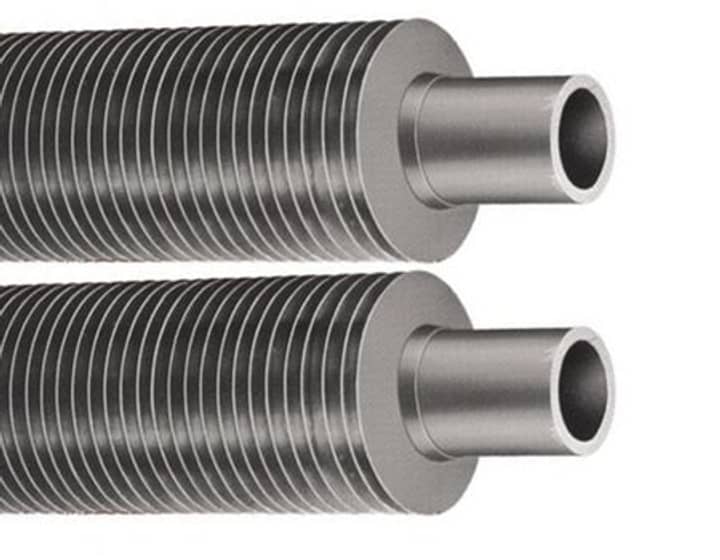
| Fin Thickness | Minimum 0.8mm, Maximum 3 Mm |
|---|---|
| Fin Height | Minimum 0.25″(6.35 Mm), 1.5″(38 Mm) |
| Fin Density : | Minimum 46 Fins Per Meter, Maximum 287 Fins Per Meter |
| Material | Carbon Steel, Stainless Steel, Alloy Steel, Inconel, High Nickle & Incolloy |
| Tubes Diameter | 30mm Od Minimum, 220mm Od Maximum |
L Footed Fin Tubes Fin Wrapping Method Footed Fin Geometry and Thermal Expansion Compatibility
Timex Metals, who are known to provide effective and stable heat transfer system across industries and engineering projects, is a well-known L Footed Fin Tubes Manufacturer that provides high-performance products in the harsh operating environments. These tubes are most popularly applied in air-cooled heat exchangers, condensers, boilers, and systems which require high thermal conductivity. They are fabricated out of good materials like stainless steel, copper, and carbon steel which give them high level of resistance against corrosion and also prolonged service life. The L-shaped fins will be bonded to the base tube mechanically and, as a result, the surface contact will be enhanced, and the heat will be dissipated evenly. G Finned Tubes are also often used in heat exchange systems in applications where the thermal efficiency needs the same value and the mounting of the fins to the tube is stable.
L Footed Fin Tubes are designed to be highly consistent in their thermal operation and continuous operation in conditions of high temperature and are designed to survive in high temperature conditions and sustain a steady thermal operation with less maintenance demands. They can be used in the industrial sphere in the long term due to their efficient heat exchange capability despite harsh conditions of use. Welded Fin Tubes are used in processes when permanent fin bonding and greater mechanical strength is needed because they offer an excellent fin-to-tube bonding and life. All these finned tube solutions work to enhance energy efficiency, stable operation and reliable performance in all industrial heat transfer solutions.
L Footed Fin Tubes – Technical & Material Grade Specification Table
| Fin Material | Fin Grade | Base Tube Material | Base Tube Grade | Tube OD (mm) | Wall Thickness (mm) | Fin Height (mm) | Fin Pitch (FPI) | Max Service Temp (°C) | Approx. Weight (kg/m) |
|---|---|---|---|---|---|---|---|---|---|
| Aluminium | AA1100 | Carbon Steel | ASTM A179 | 25.4 | 2.11 | 10 | 10 | 260 | 2.10 |
| Aluminium | AA1100 | Carbon Steel | ASTM A192 | 31.75 | 2.77 | 12 | 9 | 260 | 3.15 |
| Aluminium | AA3003 | Carbon Steel | ASTM A106 Gr B | 38.10 | 3.05 | 14 | 8 | 260 | 4.25 |
| Aluminium | AA1100 | Stainless Steel | ASTM A213 TP304 | 25.4 | 2.11 | 10 | 10 | 280 | 2.40 |
| Aluminium | AA3003 | Stainless Steel | ASTM A213 TP316 | 31.75 | 2.77 | 12 | 9 | 280 | 3.55 |
| Aluminium | AA3003 | Alloy Steel | ASTM A213 T11 | 38.10 | 3.40 | 15 | 8 | 300 | 4.90 |
- Application/Heat Transfer Role: L-Footed Fin Tubes are used in air coolers, heat exchangers and gas to air heat transfer systems, where moderate temperatures are needed and surface heat dissipation is necessary. The L shaped base of the fin wraps tightly around the base tube which adds more effective heat transfer area without reducing flexibility in the design.
- Production Process and Type: They are produced as helically-wound fin tubes, with an aluminium strip of fin material wound around the tube with a sort of L-foot shaped forming a section of the base tube surface. Mechanical contact is achieved effectively in this process creating a good thermal conductor, and able to accommodate thermal expansion during operation.
- Grades of materials: Base tubes are usually supplied in the grades of Carbon Steel, Stainless Steel, Copper or Alloy Steel as per the ASTM standards and the fins are usually aluminium. The choice of the material depends on the temperature at work, pressure range, and heat exchanger system exposure to the environment.
- Other Performance considerations: Extruded fin tubes cost more than L-Footed Fin Tubes because they are used in lower and medium-temperature applications. They are easy to maintain, have an excellent resistance to corrosion in the open atmosphere, and are utilized in the power plant, refinery, and process industries where they need reliable performance of heat transfer.
Client Project Report of Fastener
| Product Supplied | Quantity | Cities (India) |
|---|---|---|
| L-Footed Fin Tubes for Air Cooling Units | 162 Pieces | Durgapur |
| L-Footed Fin Tubes for Heat Recovery Systems | 197 Pieces | Surat |
| L-Footed Fin Tubes for Refinery Process Equipment | 208 Pieces | Jamnagar |
| L-Footed Fin Tubes for Industrial HVAC Installations | 174 Pieces | Bhiwadi |
L-footed fin tubes have an L-shaped fin base, which tightly encloses the tube surface to provide a secure thermal contact, but which is economical to fin over the long lengths. The design is mostly selected in cases where heat transfer on the air side is required in controlled temperature conditions and where mechanical bonding is adequate in long-term service. Engineers in most installations test L-footed designs along with single-fin tubes to learn the variations in the airflow behaviours, the retention of fins, and the overall weight effect. In the B2B Solutions viewpoint, well-defined tables on fin geometry, material mix, and weight per meter enable the user make informed decisions, plan the support structure correctly, and choose configurations that trade off performance and cost of operation.
Type of Sub-products
Frequently Asked Questions
How are L footed fin tubes different from other types of fin tubes?
What industries commonly use L footed fin tubes?
Countries We Export
India
Cities We Supply
Ahmadnagar
Ahmadpur
Ahmedabad
Bangalore Rural
Bangalore Urban
Bengaluru
Chandigarh
Chennai
Coimbatore
Haridwar
Hyderabad
Jaipur
Jodhpur
Jodhpur (ahmedabad)
Kalyan
Kolhapur
Kolkata
Lucknow
Mumbai
Mumbai Suburban
Murud (raigad)
Nagpur
Nashik
Navi Mumbai
New Delhi
Pune
Raipur
Rajkot
Rampura
Sion, Mumbai
Surat
Thane
Varanasi
Visakhapatnam
Moradabad
Angul
Rudrapur
Hosdurg
Gandhinagar
Rajahmundry
Durgapur
Bharuch
Panipat
Industries We Serve

Sugar

Oil And Gas Industries

Paper Mill

Power Plant

Bridge And Building

Aerospace Industries

Automobile Industry

Electrical Industry

Defense Industry

Construction & Fabrications

Ring Man Units

Railways

Gasket Industry

Pharmaceuticals Industry
Loading popular products...
Loading popular products...