Copper Bonded Earth Rod Weight Chart – Dimensional & Mass Reference
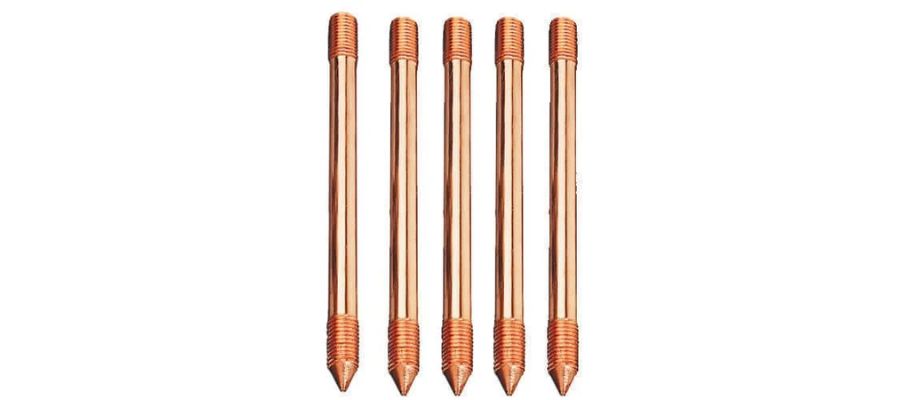
Copper Bonded Earth Rod
Copper Bonded Earth Rods are evaluated primarily on the basis of diameter, length, copper bonding thickness, and total weight, as these parameters directly influence mechanical strength and earthing efficiency. From a technical standpoint, weight charts are essential for standardization across electrical grounding systems. A certified Copper Bonded Earth Rod Manufacturers provides accurate weight references to ensure design consistency and compliance with grounding standards.
The Copper Bonded Earth Rod weight chart pdf is commonly used during engineering design, installation planning, and material verification. Weight variations occur due to changes in rod dimensions and copper coating thickness, making tabulated data the most reliable method for comparison. These charts allow engineers to match earthing components with soil resistivity and fault current requirements.
In applications requiring higher surface contact with soil, a Pure Copper Pipe Electrode is used in combination with copper bonded rods. From a weight and dimensional perspective, pipe electrodes differ significantly in mass due to wall thickness and diameter. Accurate tables help integrate both components effectively within a single earthing network.
Standardized weight and dimension tables reduce installation errors and improve long-term system performance. Manufacturers publish detailed references covering rod sizes, copper thickness, mechanical properties, and pipe electrode dimensions. The following tables provide a consolidated technical overview focused strictly on weight-based evaluation.
Table 1: Copper Bonded Earth Rod Weight Chart (Detailed)
Rod Diameter (mm) | Length (m) | Copper Thickness (micron) | Approx. Weight (kg) |
12.7 | 1.2 | 250 | 0.95 |
12.7 | 1.5 | 250 | 1.20 |
14.2 | 1.2 | 250 | 1.25 |
14.2 | 1.5 | 250 | 1.55 |
17.2 | 2.0 | 250 | 3.60 |
17.2 | 3.0 | 250 | 5.40 |
19.0 | 2.0 | 300 | 5.40 |
19.0 | 3.0 | 300 | 8.20 |
Explanation: This table provides direct weight comparison based on rod diameter, length, and copper bonding thickness.
Table 2: Copper Bonded Earth Rod Mechanical & Material Data
Parameter | Specification |
Core Material | High Tensile Low Carbon Steel |
Copper Purity | ≥ 99.9% |
Bonding Process | Molecular Bonding |
Tensile Strength | ≥ 600 N/mm² |
Standard Lengths | 1.2 m, 1.5 m, 2 m, 3 m |
Surface Finish | Smooth, Continuous Copper Layer |
Explanation: This table outlines material and mechanical properties that directly influence rod weight and durability.
Table 3: Pure Copper Pipe Electrode Weight & Dimension Chart
Outer Diameter (mm) | Length (m) | Wall Thickness (mm) | Approx. Weight (kg) |
40 | 2.0 | 3 | 18 |
50 | 2.5 | 3 | 26 |
50 | 3.0 | 4 | 34 |
75 | 3.0 | 5 | 58 |
Explanation: This table shows weight variation in pure copper pipe electrodes based on diameter, length, and wall thickness.
Table 4: Typical Weight Comparison by Earthing Component
Earthing Component | Length (m) | Weight Range (kg) |
Copper Bonded Earth Rod | 1.2 – 1.5 | 1.0 – 1.6 |
Copper Bonded Earth Rod | 2.0 – 3.0 | 3.5 – 8.5 |
Pure Copper Pipe Electrode | 2.0 – 3.0 | 18 – 60 |
Explanation: This table compares overall weight ranges between different earthing components.
Table 5: Application-Based Weight Reference
Application Area | Preferred Earthing Component | Typical Weight |
Residential Buildings | Copper Bonded Earth Rod | 1–3 kg |
Commercial Installations | Copper Bonded Earth Rod | 3–6 kg |
Industrial Plants | Rod + Pipe Combination | 8–35 kg |
Substations | Pure Copper Pipe Electrode | 35+ kg |